

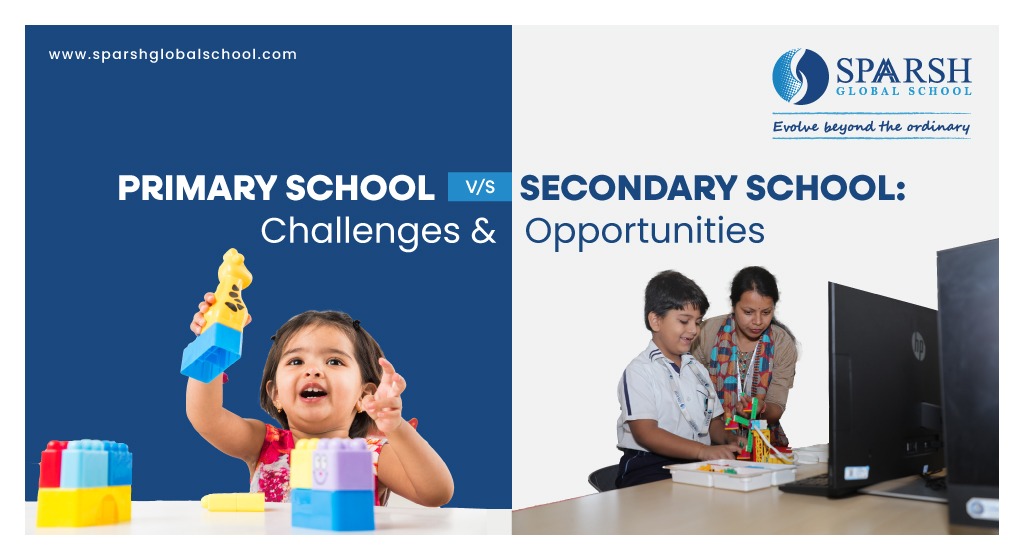
One of the key transformational phases in a student's life is the educational transition from primary school to secondary school. Although both phases form foundations for learning and personal development, they pose respective challenges and provide learning experiences that shape learners for the future. It is essential that teachers, as well as parents, be aware of the differences between these two levels of schooling. This way, children would be better prepared.
Foundational Learning in Primary School
Structured learning is introduced in primary school, typically between the ages of 5 and 11. At this stage, considerable effort is devoted to developing core skills such as literacy, numeracy, communication, and a strong scientific and social foundation. At the best school in Greater Noida West, we ensure that this crucial phase is both engaging and supportive. The primary school ambience is highly monitored, nurturing young learners as they adapt to the structure, discipline, and expectations of advanced learning. Our focused approach helps students build confidence and curiosity for lifelong learning.
At primary schools, teachers teach several subjects within the same group of students, resulting in a better relationship between students and teachers. It is through this regular interaction that a parent can determine the learning style and emotional needs of each child. Classrooms are usually small and the focus is on the person as a priority, which makes the learning environment ideal, enabling students to grow with confidence and a love of learning.
Nevertheless, the early years do not just pass without a struggle. Little kids can easily struggle with adapting to a school schedule, finding independence or controlling their emotions. Socialisation may also be a challenge, particularly for a shy person or someone who lacks exposure in a group. However, primary school is an exciting and crucial stage of development, as it offers opportunities to create new friendships, complete creative tasks and discover new knowledge.
Transition and Complexity in Secondary School
Transition to secondary school is crucial in the educational journey. Students encounter a new world where academic demands increase significantly and the learning environment becomes more complicated. They are exposed to a broader subject field, taught by specialists in the subject area and interact with a heterogeneous peer group.
Adapting to a higher academic rigour is one of the significant challenges of secondary school. To discuss various subjects and pass a range of tests, students must learn to manage their time effectively, study efficiently and motivate themselves. The transition to a subject-based model of learning may seem overwhelming at first, partly because students need time to adjust to new teaching methods and classroom interactions.
There is also a higher level of self-responsibility at the secondary school level. Timekeeping, doing homework and other tasks are all activities that learners should begin to complete independently. During this period, social issues may become more prominent, as peer influence, identity discovery and teenage anxieties come into play.
But these problems also bring great opportunities. Secondary school provides students with the opportunity to study specialised subjects in more detail, discover their interests and develop skills relevant to future professions. Co-curricular activities take on more diverse and competitive forms (through sports, music, drama, debate, etc.), providing students with an opportunity to pursue their interests and develop a more comprehensive set of skills.
There are also increased leadership opportunities at this level. Students get selected as prefects, house captains or student council members and in this way, have a chance to assume responsibility, where confidence, initiative and teamwork are developed. Moreover, access to career counselling and vocational awareness provide the knowledge that allows them to make informed decisions about their future education and career paths.
Supporting the Transition Between the Two
This transition between primary school and secondary school needs to be professionally handled so that the students do not lose their way or get demoralised with such a crucial shift. Learning institutions that undertake transition programmes, including day-long orientations, the use of peer leaders and workshops on emotional strength, prove positive and critical in the smooth adjustment of students.
Parental intervention is crucial at this age. Independence is promoted, while home support provides guidance and emotional encouragement to develop values such as responsibility and perseverance. It is also important that educators and counsellors provide constant feedback and mentorship to students during the first years of secondary school, so that they can develop emotional resilience and motivation.
Conclusion: A Shared Mission of Growth
Despite these contrasts, both primary and secondary schools share a common mission: to produce well-rounded, confident and capable learners. All of these stages are important when it comes to making students not only academically, but socially and emotionally, competent.
At Sparsh Global School, teachers recognise the importance of carefully guiding students through the necessary steps in their educational journey. Sparsh Global School carefully designs its curriculum and support systems, ensuring that each child is well-prepared to transition to secondary education with confidence and a sense of readiness and resilience to face future opportunities.
FAQ
Que.1) How can parents support their child during the transition from primary to secondary school?
Ans) Parents can support their child by maintaining open communication, encouraging time management and providing emotional reassurance. Attending orientation sessions, familiarising the child with the new school environment and staying engaged with teachers are also effective ways to ease the transition and ensure continued academic and personal development.
Que.2) What is the difference between primary school and secondary school?
Ans) Primary school focuses on building basic skills such as reading, writing, mathematics, communication, and social development.Secondary school focuses on advanced subjects, independent learning, more responsibility, and preparing students for future education and careers.
Que.3) What is the difference between elementary school and secondary school?
Ans) Elementary school focuses on basic learning, foundational skills and overall development, while secondary school provides advanced subject knowledge, independent learning, greater responsibility and preparation for higher education and future careers.