

Your child scores 92% in boards. Everyone congratulates you. For a moment, it feels like everything is on track. Then you start looking at international universities—and that reality hits a bit harder than expected.
Good marks, it turns out, are no longer enough on their own. Universities abroad are looking for things most parents were never told about. Recognised certifications. Evidence that your child can think independently. Exposure to international faculty. IELTS scores. SAT results. Things that many Indian schools don’t really prepare students for.
Most families only discover all this in Class 11. And by then, it feels like a scramble.
Suddenly, you’re signing up for multiple coaching classes. SAT in one place, IELTS somewhere else, university counselling in a third. At the same time, your child is still expected to focus on board exams—which, of course, still matter a lot.
The pressure builds quickly. Everyone is trying to keep up, but it all starts to feel rushed. Nothing gets the attention it really deserves. You can’t help but wonder—what if you had known all this earlier?
What if the preparation had started quietly in Grade 6 or 7, instead of turning into a last-minute rush? What if certifications, test prep and guidance were already part of school life, instead of something extra you had to arrange on your own?
That’s where Sparsh Global School has taken a different approach in Greater Noida.
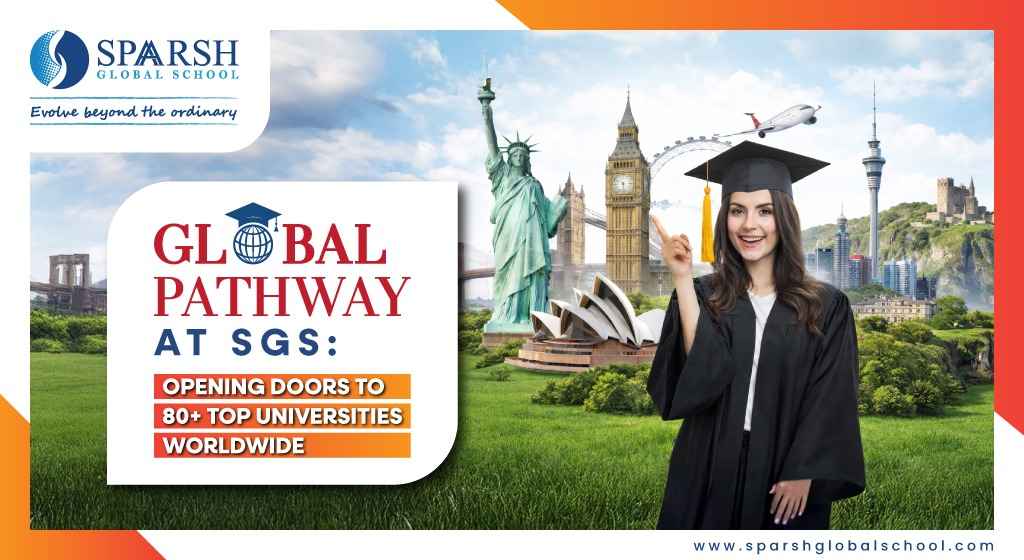
The Global Pathway programme is designed as a long-term plan, not a quick fix. It creates structured routes into 80+ universities across the USA, UK, Australia, New Zealand and Ireland. More importantly, it prepares students steadily over the years, so they’re not starting from scratch when it really matters.
Why International Universities Are Becoming a Real Option
Getting into top Indian universities has become incredibly competitive.
IIT admissions, for example, take only a small fraction of applicants. Medical seats are just as tough. For many students, it starts to feel less like a plan and more like a gamble.
At the same time, universities abroad are actively looking for Indian students. Many offer strong academic programmes, global exposure and opportunities that are sometimes harder to access within India. But studying abroad isn’t just about the degree. It’s about seeing the world differently. Learning in a new environment. Meeting people from different backgrounds. Becoming more independent. Students who return often carry a different kind of confidence—something that shows, whether they’re applying for jobs or starting something of their own. The challenge is getting there. Because it doesn’t happen by accident—it needs planning.
How Direct Admission Pathways Actually Help
At SGS, the idea isn’t to leave everything for the final year. Partnerships with universities across five countries create structured admission routes. These are formal arrangements, where universities understand the school’s curriculum and take its students seriously during admissions.
From Grade 6 onwards, students begin building profiles—not in a forced way, but gradually. They choose subjects with future requirements in mind. They work on projects that build research skills. They take on responsibilities that show initiative.
So when application time comes, they’re not trying to pull everything together in a few months. Their profile has already been built over years. That difference shows.
Certifications That Actually Mean Something
A lot of students today collect certificates—but not all of them carry real weight.
International universities look for recognised, meaningful certifications. The kind that show a student can handle deeper academic work.
At SGS, these are built into the school programme itself. Students don’t have to chase them outside. Over time, they gain certifications linked to real skills—critical thinking, research, subject depth. Nothing rushed. Nothing last-minute. Just steady progress.
Making International Education More Realistic
Cost is always a concern when it comes to studying abroad. For many families, it’s the biggest barrier. That’s why scholarship guidance is not treated as an afterthought. Students and families are supported in identifying realistic opportunities—what fits, what doesn’t and what needs to be prepared in advance. Some opportunities come through university partnerships. Others require strong applications built over time. Either way, planning early makes a difference. It turns something that feels out of reach into something that can actually be considered.
Building an Entrepreneurial Mindset Early
Universities, especially in the US, look beyond academics. They value initiative.
They look for students who don’t just follow instructions—but think, try and create.
The Budpreneur Bootcamp is built around this idea.
Students work on real ideas. Some succeed, some don’t. But that’s how it really works. They try things out, realise what’s not working, make changes and give it another shot.
They put their ideas together, look at what might actually work in the real world and then share those ideas with people who’ve been there and done it. More than anything, they learn how to think differently.
Learning From Global Faculty
One thing that helps students a lot is early exposure. Through masterclasses, students interact directly with faculty from international universities. They get a feel for different ways of learning and looking at things. Over time, they also begin to understand what universities are really looking for—not just in terms of marks, but how students think, work and carry themselves. That clarity makes future decisions a lot easier.
Test Preparation Without the Extra Stress
For most students, preparing for IELTS and SAT ends up becoming one more thing to worry about. Here, it’s handled a bit differently. The preparation is part of everyday classes, not something extra piled on top. English lessons quietly build the skills needed for IELTS, while Maths and reading sessions support SAT-style thinking. So instead of cramming at the last minute, students get used to the format and expectations over time. By the time they sit for the exams, it doesn’t feel completely new. And importantly, it doesn’t clash with board exam preparation.
Why Starting Early Changes Everything
In the end, it really comes down to timing. When things begin early, nothing feels rushed or overwhelming. Students get the space to explore what they like, pick up skills along the way and slowly find their footing. So by the time they reach the senior years, it doesn’t feel like everything is being thrown at them at once—they’ve already grown into it. Families also get time to plan, both academically and financially.
There’s space to think, instead of rushing.
Guidance That Makes the Process Easier
The application process can feel confusing. Having someone who understands it makes a big difference. At Sparsh Global School, counsellors work closely with families. They help students choose the right universities, prepare applications and present themselves well. It removes a lot of guesswork and a lot of stress.
A Practical Advantage for Greater Noida Families
Earlier, families had limited choices. Either stay local and miss out on structured global preparation, or move to bigger cities and take on higher costs. SGS changes that.
Students can access global opportunities while staying close to home. They don’t have to give up familiarity or stability. For many families, that balance matters.
A More Thoughtful Way Forward
Not every student needs to study abroad. But for those who want to keep that option open, preparation matters. Sparsh Global School’s Global Pathway isn’t about pushing one route over another. It’s about making sure that when the time comes, students actually have a choice and are ready for it. Because the real problem isn’t lack of ability.
It’s discovering everything too late.
Frequently Asked Questions
Q1. Does participating in the Global Pathway programme mean my child cannot pursue Indian universities or competitive examinations like JEE or NEET?
Ans: Not at all. The programme runs parallel to our regular CBSE and Cambridge curricula, meaning students study the same core subjects as their peers. This ensures they remain fully eligible for JEE, NEET and all Indian university admissions. The extra certifications and IELTS prep actually sharpen the analytical skills needed for competitive exams. Many of our students successfully manage both pathways to keep their options wide open.
Q2. What are the approximate costs involved and how does this compare to external coaching centres?
Ans: Our programme is integrated into the school’s fee structure, making it significantly more affordable than external coaching. Families often spend 2-3 lakhs annually on separate SAT, IELTS and counselling services, whereas our systematic, multi-year approach costs a fraction of that. Furthermore, the scholarship guidance we provide often helps families recover these costs many times over. We provide clear financial mapping from Grade 9 to ensure there are no sudden surprises.
Q3. When should students start preparing for international university admissions?
Ans: Students should ideally start preparing from middle school (Grades 6–8). Early preparation helps them build strong academic skills, develop leadership qualities, earn recognised certifications, and prepare for exams like IELTS and SAT with less pressure later.