
Choosing a school nowadays feels overwhelming, doesn't it? Your parents probably just checked the nearest decent school and enrolled you there. Done. But you know your child needs more than what got you through. The world's changed dramatically. Jobs that exist today might vanish tomorrow. Skills that seemed optional—creativity, adaptability, emotional intelligence—have become essential.
Holistic education sounds good in theory. Every school claims they do it. But walk into most campuses and you'll see the same old pattern. Academics dominate. Everything else gets squeezed into whatever time remains. A games period here, an art class there, maybe some value education once a week. That's not holistic. That's traditional schooling with minor additions.
At Sparsh Global School, we've actually rebuilt education from scratch around a simple question—what does your child genuinely need to thrive twenty years from now? Not just pass exams next month, but flourish as a human being decades ahead. Our 8-acre campus in Greater Noida West holds 4 lakh square feet of space designed specifically for this broader vision. Labs, studios, sports facilities, gardens, performance spaces. Each area serves the 'EVOLVEMENT' framework we've developed—ten interconnected pillars supporting complete growth. Entrepreneurship, Versatile Curriculum, Optimum Learning Opportunities, Lateral Thinking, Value Driven Pedagogy, Enhanced Communication, Mindfulness, Environment Consciousness, New Age Infrastructure and Technologically Advanced Innovation Labs. Not marketing language but daily reality for students here.
Let us explain ten concrete ways SGS leads holistic education, beyond just claiming we do.
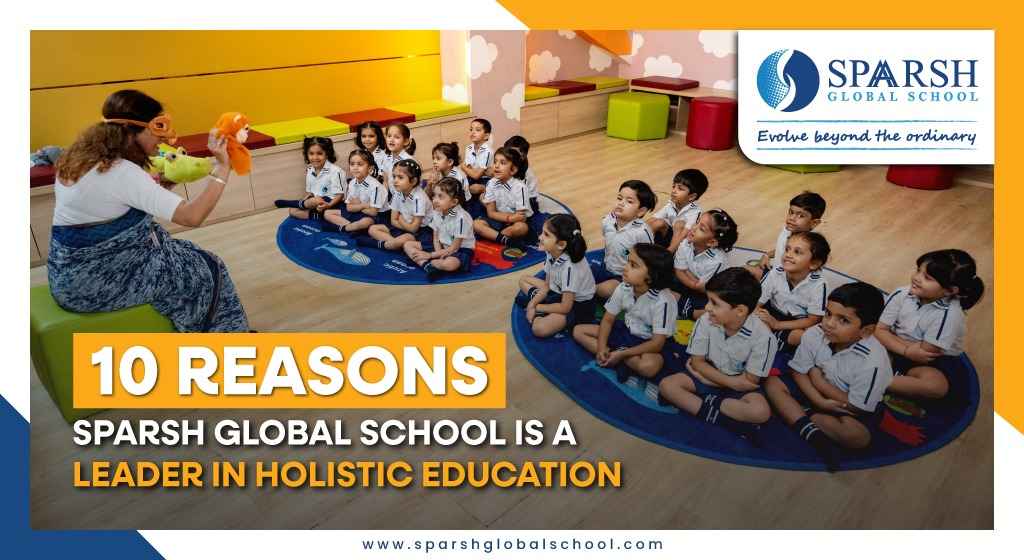
Teaching Adapts to Children, Not Vice Versa
Standard schooling operates like a factory assembly line. Thirty children enter a classroom. Teacher delivers the same lesson at the same pace. Everyone takes the same test. Efficient system for processing students. Terrible system for actual learning.
We've rejected this model completely. Our approach recognises something obvious that most schools ignore—children learn differently. Your daughter might understand fractions through visual diagrams whilst her friend needs physical objects to manipulate. One student writes brilliant stories but panics during oral presentations. Another thinks aloud beautifully but struggles putting thoughts on paper.
Our teachers plan lessons with multiple entry points deliberately built in. Visual learners get diagrams and charts. Kinesthetic learners get hands-on activities. Auditory learners get discussions and explanations. Assessments offer choices too. Demonstrate understanding through a presentation, a written report, a model or a performance. Your pick.
Takes more work than one-size-fits-all teaching, obviously. But watching a child who'd been labelled 'weak' suddenly excel because someone finally taught them properly? Worth every extra hour of planning.
Hands-On Experience Beats Lectures Every Time
Quick question—what stuck better from your school days? That Geography chapter about river erosion you memorised for the exam, or that field trip where you actually saw rock formations and collected samples?
Learning by doing isn't just more fun. It's neurologically superior. When children build circuits in addition to reading about electricity, create chemical reactions after memorising equations, grow plants post studying photosynthesis—knowledge embeds differently. Deeper. Stickier.
Our Innovation Labs get used constantly, not saved for parent visit days. Students build robots that actually move. Code programmes that solve real problems. Run chemistry experiments that sometimes fail spectacularly, teaching them debugging and resilience. Design prototypes using 3D printers.
When things go wrong—motor won't start, code crashes, experiment produces unexpected results—children don't panic. They troubleshoot systematically. That problem-solving instinct? Can't teach it through textbooks, however brilliantly written.
Facilities That Enable Discovery, Not Just Impress Parents
Our campus tour often surprises parents. Yes, we've got smart classrooms with digital boards and tech integration. These are anyways expected nowadays. But then they see the music recording studio where students actually produce songs. Dance studio with professional flooring and full mirrors. Pottery studio with working kilns. Separate Innovation and Incubation Labs serving different purposes.
Science education happens in dedicated, fully equipped labs for Physics, Chemistry, Biology. Not one shared lab used sparingly. Students can experiment frequently because space exists for it.
Sports infrastructure rivals many professional facilities. Half-Olympic swimming pool, not a tiny learner pool. Proper cricket pitch and grounds. Multiple basketball courts. Badminton halls. Skating rink. Tennis and squash courts. Shooting range with certified instructors. Archery setup. Fully equipped gymnasium.
Why this investment?
Because children discover themselves through varied experiences. Your quiet, bookish child might transform during theatre. The restless student struggling academically might find focus through archery. The shy one could bloom during music. We've created physical space for every type of discovery.
Sports Daily, Not Weekly
Sports at SGS happens every single day because we've observed something schools often miss—physical development directly shapes everything else. The discipline from regular practice transfers to study habits. Teamwork during matches teaches collaboration for projects. Learning to lose gracefully builds emotional resilience for life's inevitable disappointments.
Students choose from about twenty sports options. Team games like football, basketball, volleyball, cricket. Individual pursuits like swimming, skating, shooting, archery, tennis. Martial arts for self-defence and discipline. Yoga for flexibility and mental calm.
Real coaches train them, not just PE teachers filling time. Regular competitions happen—inter-house, inter-school, external tournaments. Children experience actual competitive pressure, learn handling nerves and discover how they respond under stress.
We've watched remarkable transformations. Timid children gaining confidence through sports achievements. Hyperactive students channeling energy productively. Natural athletes finding excellence paths. Sports isn't extra here—it's core curriculum.
Six-Year-Olds Learning Business Thinking
This catches parents off guard initially—entrepreneurship education from Grade 1. You're probably imagining us teaching stock markets to first-graders. Not remotely.
Primary students run mini-markets in class. Make simple products. Price them. Handle toy money transactions. Count profits and losses. Basic economics through play.
Middle school gets serious. Students identify actual problems around them. Brainstorm solutions. Build prototypes. Present pitches explaining their ideas. Some work, some flop. Both outcomes teach.
Senior students use our Incubation Lab for genuine ventures. Market research. Business planning. Product development. Several have launched real businesses post-graduation.
But here's the thing—most of your child's classmates won't become entrepreneurs. So why bother? Because entrepreneurial thinking—spotting opportunities, creative problem-solving, calculated risk-taking, handling failure productively, pivoting strategies, communicating persuasively—helps everyone. Future doctor, teacher, engineer, artist, scientist. Everyone needs these skills.
We're raising people who create opportunities instead of just hoping opportunities find them.
Technology as Learning Tool, Not Distraction
Every student from primary onwards receives a tablet. Parents sometimes worry—aren't you just creating screen addicts? Fair concern. But screens aren't the problem. What children do with screens determines everything.
We use tablets for blended learning. Classroom teaching combines with digital resources, interactive exercises, research projects. Children learn the same content through multiple modalities.
Coding classes start early. Not just syntax and commands, but computational thinking—breaking complex problems into steps, debugging systematically, creating algorithms, logical reasoning. These thinking patterns transfer far beyond programming.
Innovation Labs expose students to robotics kits, 3D printers, design software, emerging tech. They don't just learn about technology. They create with it.
Digital citizenship gets taught alongside digital skills. Online safety. Responsible social media use. Evaluating information critically. Protecting privacy. Using technology purposefully, not compulsively.
The future waiting for your child involves technologies we cannot imagine yet. We're ensuring they're not intimidated by change, but capable of navigating it confidently.
Arts as Foundation, Not Decoration
Walk past our art facilities any afternoon. Music studio has students recording actual songs. Dance studio hosts rehearsals for upcoming performances. Pottery studio has clay-covered children shaping bowls on wheels. These aren't occasional special activities. They're regular curriculum.
Here's why this matters. Learning doesn't begin with letters or numbers. Infants respond first to sounds, colours, movements, patterns, textures. Art taps into these foundational ways humans understand the world.
Music teaches mathematical patterns alongside artistic expression. Dance builds physical awareness and discipline. Theatre develops confidence and empathy. Visual arts sharpen observation. Pottery requires patience and precision.
Even students who never pursue arts professionally gain tremendously. Stage performance builds public speaking confidence. Music practice teaches persistence. Art projects develop creative problem-solving. These capabilities transfer everywhere.
We've kept arts central because we understand—creativity isn't luxury. It's necessity for navigating an unpredictable future.
Learning Values Through Actual Experience
SGS partners with organisations bringing real-world learning into student lives. SPIC MACAY doesn't just lecture about Indian classical traditions. They bring performers directly to campus. Students experience living culture, not museum artifacts.
Duke of Edinburgh Award programme pushes students beyond comfort zones through Bronze, Silver and Gold level challenges. Service projects.It is all about honing new skills, getting active, and embarking on those adventurous journeys that really test your mettle.These commitments push students properly, and the growth sticks with them long after.
Our Interact Club works with Rotary to connect students aged 12-18 with actual community service and leadership opportunities. Not the symbolic gestures schools photograph for annual reports. Real work in villages and settlements around our campus.
Students lead environmental awareness programmes. Run hygiene campaigns in communities where basic sanitation remains a struggle. Support education for children whose families can't afford school fees. They're not sitting in class reading a chapter about social responsibility. They're out there doing it, getting their hands dirty, seeing direct impact.
Understanding privilege, contributing something meaningful, developing genuine empathy—these emerge through experience, not Moral Science textbooks, however good the teacher might be.They emerge when your child spends a Saturday teaching underprivileged children or organizing a cleanliness drive in a neighboring area. Experience teaches what textbooks simply cannot.
Wellbeing First, Performance Follows
The truth is, academic pressure can really wear a child down if a school chooses to ignore their emotional health. We've built comprehensive support systems because we've learned—wellbeing enables everything else.
Daily yoga and meditation teach children emotional regulation tools. Examination stress building? Friendship troubles? Family issues? They've got techniques for managing feelings instead of drowning in them.
Professional counselling provides confidential support. No stigma attached. Just care when needed. Academic struggles, social challenges, personal difficulties—trained counsellors help children navigate.
Our meal programme ensures proper nutrition supporting physical growth. Balanced diet, appropriate portions, table manners, lifelong healthy eating habits.
Infirmary handles health needs immediately. Qualified staff, medical equipment, clear emergency protocols. Your child's safety stays paramount whilst they explore and grow. Healthy, emotionally balanced children learn better.
Questions Before Answers
Our teachers frustrate some children initially because we don't just deliver information for memorisation. We constantly ask 'why', 'how' and 'what if'.
roject-based learning is where different subjects start to lean on each other quite naturally. Take a rainwater harvesting project, for instance. It isn't just one thing; it pulls in Science to understand the water cycle, Mathematics to work out storage capacities, and Social Studies to look at how water affects the local community. Then you have Language Arts for the messaging and Art for the posters.
It proves that real-world problems rarely stay inside neat little subject boxes. Our students quickly learn that being able to ask a really insightful question is just as valuable as stumbling upon the right answer. Research skills develop through actual investigation, not just copying encyclopaedia entries. Critical thinking improves because they're constantly evaluating information quality, not just accepting whatever they read.
We're developing minds that analyse, question and create. Not just memories that store and recall. Higher-order thinking matters far more long-term than memorising periodic tables for examinations.
Your Child's Complete Evolution
Education at Sparsh Global School extends beyond next week's quiz or next year's boards. We're genuinely invested in developing young people ready for a complex, unpredictable future. Our holistic approach ensures that children carry forward not just academic knowledge, but character, creativity, confidence and compassion when they eventually leave us.
Everything built here—facilities, programmes, partnerships, teaching methods—serves one purpose. Helping your child evolve into an extraordinary person ready to contribute meaningfully wherever life leads them.
Frequently Asked Questions
Q1. What makes Sparsh Global School's approach to holistic education different from other schools?
We don't just add extra activities alongside academics—we've fundamentally integrated multiple development areas into our daily structure. From entrepreneurship education starting in Grade 1 to our Innovation and Incubation Labs, from 20+ sports options to dedicated art studios, everything happens as part of regular school life, not as optional extras. Our child-centric methodology adapts to individual learning styles rather than forcing every student into one mold. The partnerships with organisations like SPIC MACAY and Duke of Edinburgh Award further extend learning beyond campus, whilst our mindfulness curriculum ensures emotional wellbeing supports academic growth.
Q2. How do you balance academics with all these other activities without compromising examination results?
The question assumes academics and holistic development compete against each other, but we've found they actually strengthen each other. Children who engage in sports develop discipline and time management. Arts education builds creativity and confidence that helps in all subjects. Experiential learning through our labs makes academic concepts stick better than rote memorisation ever could. Our blended learning approach using technology makes studying more efficient. Most importantly, when children are emotionally balanced through our wellbeing programmes and genuinely interested in what they're learning, academic performance improves naturally. We're consistently achieving strong results precisely because we don't treat education as just exam preparation.