


The landscape of education has seen a sea change over the past decade with new learning methods following suit. In learning rooms across the globe, a longstanding debate has been; should schools emphasise on skills-based learning? Here is a world where flexibility, imagination and critical thinking are worth much more than erstwhile memorisation.
Understanding the Two Techniques
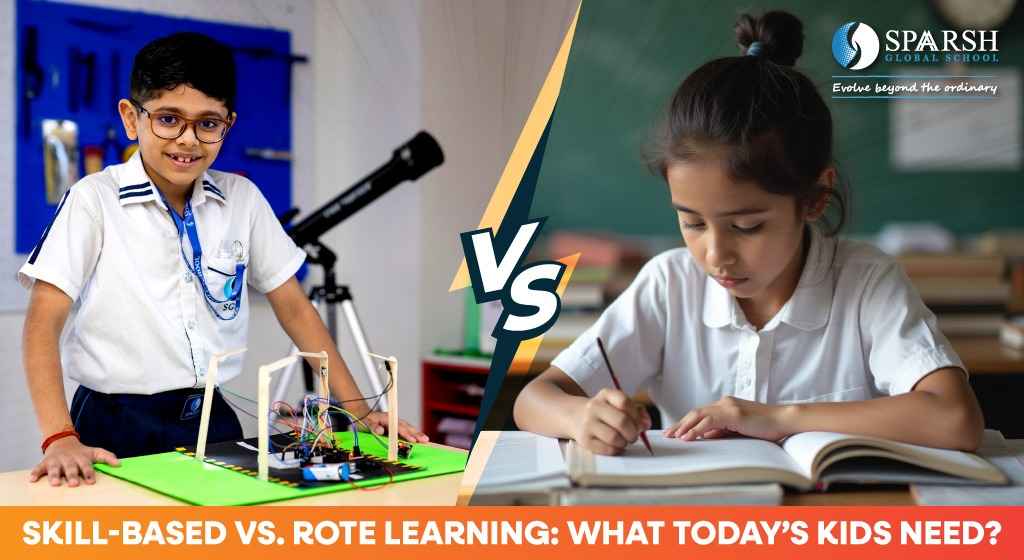
Rote learning is an older method based on repetition and memorisation. Students are encouraged to memorise facts, formulas, vocabulary and procedures through practice and repetition. While the technique can be highly efficient for a few basic concepts, it often lacks context.
In comparison, skill-based learning emphasises on the acquisition of practical, transferable skills such as problem-solving, communication, teamwork and digital literacy. It requires students to apply their knowledge in real-world contexts, often through project-based activities, interactive forums and hands-on learning.
Why Rote Learning is Falling Behind
Rote learning weaknesses come into sharper focus in today’s Information Age. Students no longer need to memorise an enormous amount of facts when a computer can summon the data in seconds. Students now must learn how to interpret, analyse and efficiently employ the information.
Moreover, rote learning can also suppress curiosity. As students are pushed only to remember things for tests, there could be forgotten avenues for real engagement with disciplines. Rote learning can lead to a lack of interest, anxiety and even burnout, particularly when test results are the standard for achievement.
The Emergence of Skills-Based Learning
Skills-based learning fosters a rounded, student-centred approach. Differing from traditional education, which presents a series of facts in order, this method promotes greater depth and active involvement. Students are challenged to think critically, solve complex problems and express their thoughts with confidence.
Employers are now consistently emphasising on the importance of “soft skills” such as flexibility, teamwork and emotional intelligence. Such a skills-based education system is a closer match in expectation, with students well-prepared for life after graduation, with careers that potentially hold yet unimagined realities.
Moreover, skill-based learning promotes lifelong learning. By developing curiosity and initiative, students are more likely to continue learning long after their formal schooling.
Balancing Both Worlds
To underrate the role of rote learning would be a mistake. Other forms of knowledge, particularly in children, involve memorisation before deeper learning is possible. Tables, phonics and scientific vocabulary are usually mastered through repetition, which provides a solid foundation.
But the key is a smart trade-off. Top CBSE schools in Greater Noida West should attempt to provide rote learning where it is inevitable, yet insist on developing skills in the majority of the curriculum. By doing so, students can be provided with a cache of facts, along with a means for productively utilising the information.
The Role of Teachers and Schools
Teachers hold the key. Teachers are learning facilitators, rather than simply transmitters of information. It means developing lessons where students are challenged to pose questions and there are assignments where students are helped in working with challenging problems.
Even educational institutions must rethink the measurement of progress. Standard testing can remain among a key set of tools; however, project presentations, group work and portfolios provide a more comprehensive perspective on the learner's skills.
A Future-Focused Approach
In embracing skill-based learning, schools are only following global trends—but equipping students for a life much beyond. The world is changing at an unprecedented speed, with new technologies, industries and societal needs continuously reshaping the future. Learning needs to keep up. Sparsh Global School recognises the need for this shift. By developing a learning environment where skills are promoted, critical thinking is respected and innovation is encouraged, Sparsh Global School is equipping its pupils for something greater than academic success—a life of meaning beyond the four walls of the classroom.
FAQ
1. Why is skill-based learning considered more relevant than rote learning in today's educational landscape?
Skill-based learning is increasingly viewed as more relevant because it prepares students for real-world challenges by fostering critical thinking, communication, collaboration and adaptability. Unlike rote learning, which relies heavily on memorisation, skill-based approaches encourage application and problem-solving skills that are essential in today’s dynamic, technology-driven world. With information readily accessible through digital platforms, the emphasis has shifted from recalling facts to effectively interpreting and utilising them.