

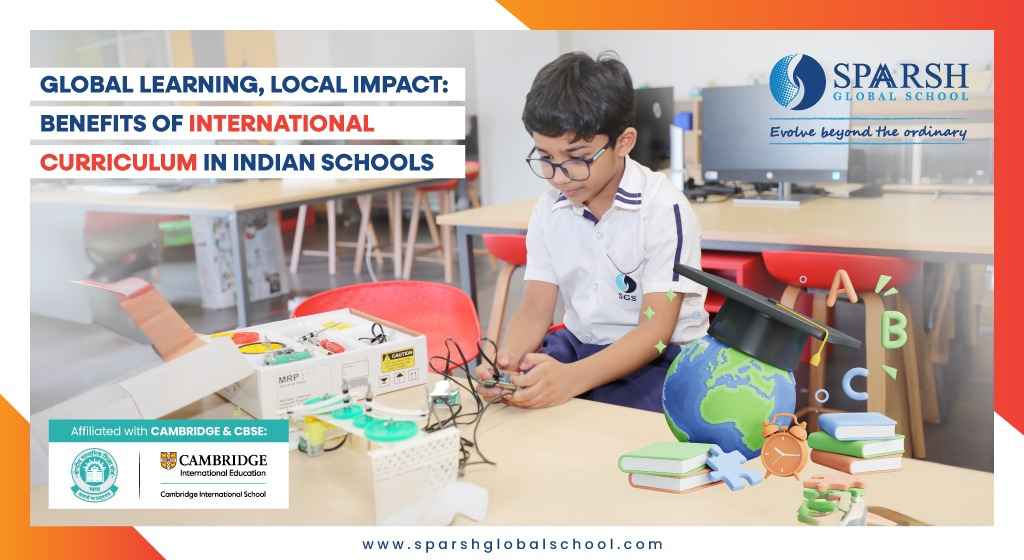
The world is an interconnected landscape where borders have been made seamless. Today education has transgressed geographical boundaries and has emerged in the form of an international curriculum, which introduces students to the happenings across the globe across subjects and lends them a global perspective from an early age. International curricula have gained prominence and such curricula help students experience global standards of education while remaining connected to their own culture and community. The implementation of global education programmes in India, including the International Baccalaureate (IB) and the Cambridge Assessment International Education (CAIE), as well as other international curricula, has increased significantly over the years, with numerous benefits for learners.
Fostering a Global Perspective
The benefit of having a global perspective is an essential feature of international curricula. Students are exposed to diverse cultures, ideas and challenges from around the world, enabling them to become intelligent and open-minded global citizens. Few of the relevant and important subject knowledge imparted are Environmental sustainability, human rights and economic development. These allow learners to think beyond local and national issues. Such exposure enables students to value other opinions and develop empathy and respect for different cultures. These are traits that are increasingly becoming crucial in the current world.
Emphasis on Critical Thinking and Inquiry
Some educational systems formerly focussed on rote memorisation. Conversely, modern and international curricula lay emphasis on inquiry-based learning, critical thinking and problem-solving. Students are expected to raise questions, explore matters independently and draw rational conclusions.
This is a paradigm shift from passive receiving of information to active involvement in it that makes students ready to meet the challenges of the new world. They are more apt to break down problems, express themselves and collaborate effectively, all of which become more desirable in both higher education and the workplace.
Personalised and Holistic Education
The international education curricula take a student-centred approach, where every child learns in a different way and possesses unique abilities and interests. They offer a wide variety of topics and evaluation techniques, making it more individualised. The arts, music, technology and physical education subjects are given equal status and students are encouraged to become well-rounded individuals.
Additionally, social and emotional learning is provided with due attention. The curricula also include programmes that develop not only academic perfection but also emotional intelligence, resilience and leadership. Such a wholesome approach equips students with the skills to navigate life's seasons, both ups and downs, with a level of maturity and confidence.
Seamless Transition to Global Higher Education
The other key positive attribute of international curricula is that they provide a smooth avenue for students pursuing higher education in foreign countries. Such curricula are highly regarded and well-known, especially in the United States, the United Kingdom, Canada and Australia, among others. They uphold international academic standards and evaluation systems, which are nearly identical to those desired by global institutions.
Indian students who complete their studies in an international curriculum school usually gain an advantage when applying to a foreign institute, primarily due to the reputation of the curriculum and the competencies they are trained in, including independent research, writing essays and public speaking.
Enhancing Teacher Expertise and Professional Growth
Teachers also gain tremendously from the use of international curricula. Professional training is provided to teachers on a large scale, enabling them to adapt to international standards of pedagogy and education. This helps them not only to be better teachers, but also to create a culture of learning and cooperation.
International Schools in greater noida west welcome their teachers to participate in international conferences and exchange programmes. This exposure enhances the level of classroom instruction and keeps students under the guidance of highly enlightened and motivated tutors.
Local Impact of Global Learning
Although international curricula are global in their scope, their implications are highly local. Students take home the knowledge, values and skills they have learned and become agents of change themselves. They participate in local initiatives e.g. starting a recycling campaign in their neighbourhood, coming up with technological solutions to local issues, or volunteering in social causes, helping their immediate environment.
Moreover, the existence of internationally affiliated schools in India enhances the entire educational ecosystem. They have established a yardstick in terms of innovation, infrastructure and pedagogy where other institutions are challenged to expand their horizons.
Conclusion
The incorporation of international curricula in Indian schools represents a potent combination of global standards and local contexts. These programmes not only prepare students to face the world outside but also equip them to make a tangible impact in their communities. In fact, they reflect 5 key ways the best schools prepare students for the future—by fostering adaptability, global awareness, and a strong sense of social responsibility. That way, they help to build a more flexible, open-minded and understanding generation of learners.
Sparsh Global School is truly the successor to this vision of creating an international school that embodies the best of the nation around the globe, with students being imparted with international levels of education while upholding Indian traditions and cultures. Through global competency and local awareness, Sparsh Global School empowers its students not only to be internationally prepared, but also to be equally dedicated to making a purposeful difference locally.
FAQ
1. How does an international curriculum benefit Indian students who wish to pursue careers in India?
An international curriculum equips Indian students with essential 21st-century skills such as leadership, communication, collaboration and problem-solving. Modern Indian industries and organisations highly value these competencies. Moreover, the global exposure and adaptability gained through such curricula make students competitive in both domestic and international career markets.