


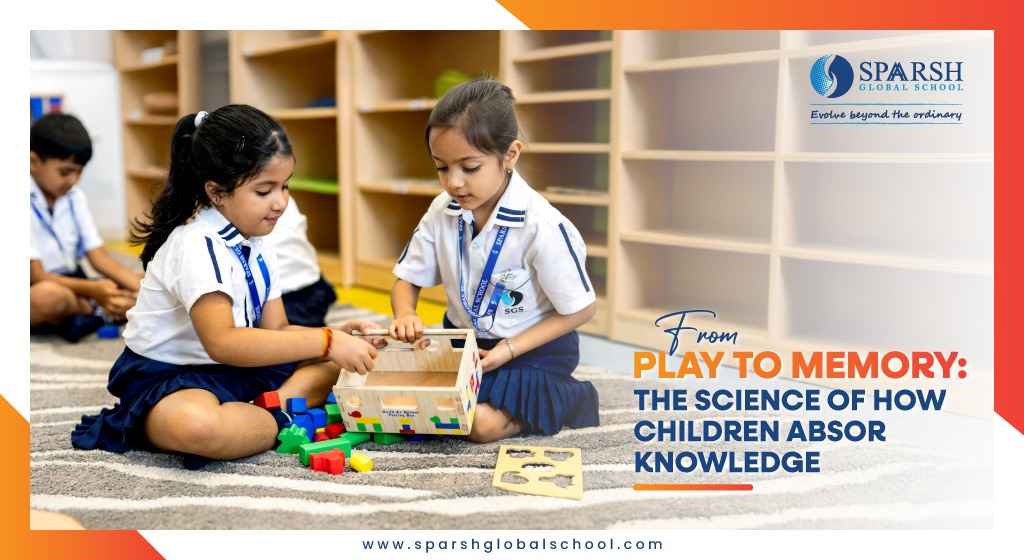
The learning of young children has been a subject of speculation among educators and scientists for decades. However, there is one thing that is clear and that is, children learn best by not memorising things, but by being exposed to the world around them, through play methods. This acts as a strong learning device as their brains are still in the development period and simple moments can be easily turned into permanent knowledge.
Why Early Experiences Matter?
In early childhood, the brain is highly dynamic and constantly growing in its own way, forming entirely new sets of connections —a process known as neuroplasticity. That is why early learning has such a profound influence. When children are fully engaged, whether playing with their peers to build towers, acting as doctors or learning in the wild, they are not merely playing; they are enjoying themselves and are establishing the neural pathways upon which future learning, thinking and problem-solving depend.
How Play Builds Memory
The play method of learning is not only fun, but also very educational. It stimulates multiple parts of the brain simultaneously. Movement games enhance coordination and motor skills, while also developing memory through rules and repetition. Imaginative games, storytelling, role-playing, language, creativity and recalling knowledge to apply are all developed.
This has a lot to do with what is referred to as episodic memory, specifically our ability to recall specific events. When a child is enthusiastic about what they are doing, it becomes more likely that they will remember it better. Studying money, counting and interacting with others can be learned more effectively through a game of shopkeeper and customer, than on a worksheet.
From Moments to Meaning
Gradually, what children learn through play finds its way into their semantic memory: the repository of information and general knowledge that children can access in their everyday lives. The child who has practised playing with coins or running a shop can subsequently have an easier time grasping maths and money since these concepts were built on enjoyable activities.
Nurturing Curiosity and Confidence
Children always tend to be inquisitive. Play-based learning fosters them to discover the unknown in areas of interest, inquiry and in defining their learning. This sense of ownership makes learning more critical. Children are motivated and inspired when their learning is voluntary, without any imposed pressure, as they explore and develop their curiosity.
The Role of Sleep in Learning
When the school day ends, learning continues. Sleep plays a vital role in storing and organizing new knowledge, especially for children at a CBSE school in Greater Noida West. The brain continues to function after a tiring day filled with activities and explorations, converting short-term memory into long-term memory. It is simply one more argument in favour of the balance of routines, including both play and rest.
Learning Through Social Interaction
Social development also uses the aspect of play. Children are taught to cooperate, listen, take turns and share their ideas through mutual games and creative situations. These social experiences foster empathy, strength and cooperation, which are essential not only in school, but also in life.
A More Thoughtful Approach to Education
Based on these understandings, there is a move towards a child-centred, play-based method of teaching and learning in many schools. As learning is associated with pleasure, curiosity and creation, children become more immersed in the process and the outcomes usually are positive. Classrooms today are lively and dynamic, where ideas can be discovered and explored, rather than imposed.
Sparsh Global School: Where Learning Begins with Play
Sparsh Global School is one of the schools that fully embodies this philosophy. The notion that learning is generated through play is not merely an opinion, but a guiding principle—just like the idea behind 5 Easy Steps to Create a Perfect Daily Study Timetable for Students, where structured learning blends with balance and enjoyment.The school approach is a research educational approach which is intended to make children learn in real life situations through imagination, play, experimenting and thinking about things.
At Sparsh Global School, play is embedded in all areas of the curriculum. Whether it is in the classroom, on the playground or during practical tasks, children are surrounded by experiences that encourage curiosity and foster greater knowledge. The school integrates the academic courses with creative research and this makes the knowledge acquisition memorable.
SGS is an excellent institution that provides parents an educational system that values both fun while learning and creativity, while appreciating genuine understanding of concepts. The school provides the right environment where children can become confident and competent learners - not only school-ready, but also life-ready.
FAQ
1. How does play support long-term memory and academic success?
Play stimulates multiple areas of the brain and strengthens both episodic and semantic memory. When children are emotionally engaged in an activity—such as role-playing, building blocks or storytelling—they are more likely to retain what they’ve learned. These experiences form strong mental connections that support future academic learning in subjects such as literacy, numeracy and science.