
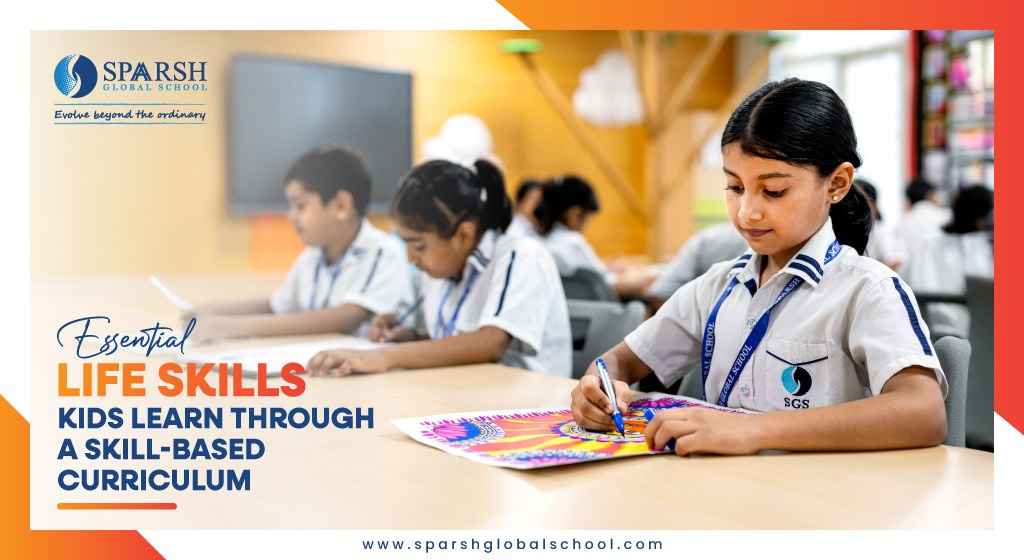
The basic tenets of education have undergone a paradigm shift. In this increasingly changing world where emphasis is placed on critical thinking, creativity and adaptability, modern education systems are evolving towards a skill-based curriculum, with an added emphasis on practical skills and their transferability in day-to-day life. Such a curriculum also fulfils the purpose of equipping students with intellectual know-how as well as with life skills, highly relevant in life beyond the classroom.
Problem Solving and Critical Thinking
A skills-based curriculum helps children develop critical thinking skills at a very early age. Instead of memorising answers, students are needed to analyse, evaluate alternatives and make well-supported conclusions. This type of learning is based on curiosity, prompting students to ask questions and consider multiple options when making decisions. Considering multiple solutions to the same problem, doing deep research, cultivating critical thinking are necessary skills in today’s world which go a long way in helping children explore career options and even in navigating through interpersonal relationships.
Communication Skills
Effective communication forms the basis for any life achievement. Students achieve oral and written communication skills through group exercises, presentations and project work. Listening carefully and adapting one’s communication as per the likes and desires of the target audience is a key condition in effective communication. Strong communication skills ensures not just sound academic performance, but imbibes in students the confidence to stride ahead in life.
Collaboration and Teamwork
A key aspect in today’s seamless world in working in diverse groups, across a multitude of cultures. Students typically work in teams on projects, learning to manage group interactions, resolve conflicts and make valuable contributions toward group outcomes. Getting an exposure to working in a team with diverse students belonging to varying backgrounds develops an understanding toward differing opinions, value for shared responsibility, factors so crucial in a professional career as well as in personal life.
Time Management and Organisation
Skill-based learning comprises independent research and self-driven tasks. It empowers them to schedule their activities in a smart manner. Learning time management early in life equips children with the ability to manage academic demands with extracurricular activities, as well as manage their career and personal life with greater efficiency in the long term.
Creativity and Innovation
A skills-based curriculum, unlike a rigid academic approach, breeds innovation through challenges, with new concepts, out-of-the-box thinking and new solutions.. Innovation is no longer an abstraction, but a disposition that inculcates in students the power to adapt in an ever-changing environment and thrive in a wide range of professions.
Resilience and Adaptability
Learning in the real world requires students to be armed with resilience, which pushes them to think harder and deeper. Facing repeated setbacks and failures becomes necessary in developing emotional strength and a growth mindset. Coping and collaborating with a myriad of different situations, team members across the country and the globe requires adaptability. This skill enables students not just to adjust to new situations and embrace challenges with confidence, but to find creative ways to overcome obstacles. They become better prepared to turn uncertainties into opportunities and thrive in both their academic journey and future careers.
Digital Literacy and Technological Proficiency
Digital literacy is the new normal in academics, an absolutely essential skill in the 21st century. Technological programmes that introduce the use of information into everyday learning processes build upon internally focused curricula and prepare students to solve realistic problems by using digital materials, researching through the World Wide Web and addressing the ethical implications of technology usage. These are the competency areas needed in future employment. Management of information and communications in a professional, responsible and accountable manner is a key skill.
Financial and Civic Literacy
Some models of skill-based learning also incorporate elements of financial literacy, teaching children about managing money, understanding the concept of savings, and making informed economic decisions. Additionally, civic education instils in children a sense of social responsibility, teaching them about their rights and obligations toward society. Such life skills make students well-informed, responsible and participatory members of society.
Self-Awareness and Emotional Intelligence
Emotional intelligence may be one of the strengths of a skills-based curriculum. Reflecting, mindfulness practice and social-emotional learning help students gain a better understanding of their emotions and acquire the skills of controlling stress, as well as empathising with their classmates. Good mental health has a foundation in strong relationships built through self-awareness.
Conclusion
The move towards a skills-based curriculum is a step toward a holistically minded approach to learning—a learning approach designed for life in the contemporary world. By focusing on life skills, such as communication, resilience, problem-solving and teamwork, children become competent and self-confident individuals. A progressive approach towards this thinking is taken by Sparsh Global School, a leading school in Greater Noida West, where skills are taught as a lifelong process. Sparsh Global School blends new learning approaches with a strong focus on life skills, preparing students not only for academic success, but also to grow into emotionally intelligent, socially aware and future-ready individuals.
FAQ
1. What are the key benefits of a skill-based curriculum for students?
A skill-based curriculum equips students with abilities they can use in real life like critical thinking, communication, teamwork, time management, and emotional intelligence. Instead of relying on rote memorisation, it encourages meaningful learning that truly makes students future-ready. Students become more adaptable, confident and better prepared for future challenges, both academically and in personal life.